
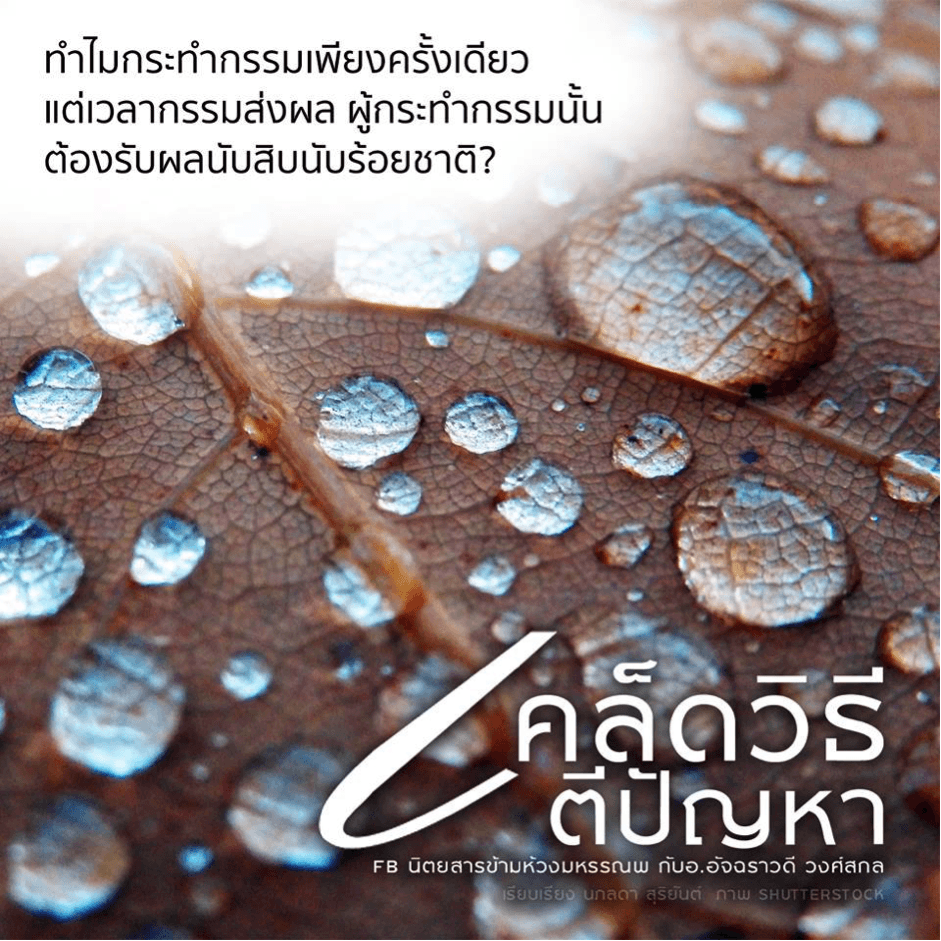
"Why does one have to take consequences for many hundreds lives from one's single bad deed?"


“Why does one have to take consequences for many hundreds lives from one’s single bad deed?”

Consequence of Not Appreciating Others’ Kindness
July 17, 2018
“We should do that to the mother”
August 2, 2018Consequence of Not Appreciating Others’ Kindness
July 17, 2018“We should do that to the mother”
August 2, 2018


|
|
Answered by the Master Acharavadee Wongsakon
(Please find Thai version below)
Why does a single bad deed (Karma) of a person take effect onto the person for many tens or hundreds life cycles of rebirth?
Answer: The consequences of bad deeds or bad Karma will take on up to tens or hundreds life cycles of rebirth (‘lives’ in short) because they depend on 2 causes: the intention to harm, hurt, destroy, insult, victimize etc.; and the level of Dhamma the persons being harmed, hurt, destroyed, insulted, victimized, etc., uphold. The higher level of Dhamma or the purer the mind of the persons being hurt etc. , such as the highest as Buddha (self-enlightened one, propagate Buddhism teaching and extend Buddhism for thousands years), Self-enlightened Buddha (very wise so become enlightened by one own self), Bodhisattava (taught until enlightened and sacrificially care for others well-being while alive), Arahant (taught and enlightened) and ‘Aariya’ persons (taught, purely uphold to clean precepts, rigorously practice on the right path, and guaranteed to be enlightened at most within 7 lives).
The strength of Karma or bad deeds done on these persons ranked by the level of upheld Dhamma will take heavy consequence many tens, hundreds or even thousands of lives, well beyond one Buddha era, accordingly. Bad deeds done on animals, such as dogs, cows, etc., will take effect over many ten life cycles of rebirth as well if the actions to hurt, kill, harm, ..etc. are done with intention or effort.
A story in the Tripitaka is an example. There is a lady who is always followed by a dog everywhere she goes until her community detests. This, in fact, is because the dog is much bonded to her since in the past life as her husbad. Not knowing the cause, she becomes so shameful of being followed by the dog much that she plans to kill it. She tricks it and successfully manages to immerge it to a deadly drown. The Karma starting from pondering, engrossing in planning till making the act of killing weighs more and more heavily, doubling, quadrupling, so on until she has taken on the Karma results for seven lives by being immerged to seven deadly drowns. Karma consequence can be very strong depending also on one’s intention even if an action is on an animal.
Buddha says ‘everything is led by the mind’ meaning the mind is the scale and machine sending out the consequence of Karma. Karma that is heaviest or sending out the worst consequence ever is ‘Karu Karma’ or ‘Ananta Aariya Karma’ which is killing father, mother, harming Buddha to bruise and more, or disuniting monks one way or another.
The lightest Karma or bad action that results in the lightest bad consequence is ‘Katatta Karma’ or action done without intention. That is an action completed simply for the sake of getting it done, or done traditionally or done without a full belief or trust. Deeds conducted simply like this will have consequence only little, on either positive or negative sides. A good deed will pay a positive benefit later but little, similarly to a bad deed resulting a little bad effect later.
If you let every question or puzzle you have linger, it will be question/puzzle always. But, if you dare to ask, wisdom will light up for you to stay on Buddhism practice journey correctly. Just simply send your question to napalada.suriyunt@hotmail.com. The master will take care answering your every question.
เคล็ดวิธีตีปัญหา: ทำไมทำกรรมครั้งเดียว ต้องรับผลนับร้อยชาติ?
ตอบโดย อาจารย์อัจฉราวดี วงศ์สกล
ทำไมผู้ที่กระทำกรรมเพียงครั้งเดียว แต่เวลาผลกรรมนั้นส่งผล ผู้กระทำต้องรับผลนั้นเป็นสิบเป็นร้อยชาติ
ตอบ ผลกรรมจะส่งผลแรงเป็นสิบเป็นร้อยชาติ ขึ้นอยู่ด้วยเหตุ 2 ประการทำด้วยเจตนาทำร้าย ทำลาย ลบหลู่ดูหมิ่น บุคคลที่ไปกระทำ ท่านเป็นผู้ทรงธรรม เป็นเนื้อนาบุญสูงส่ง ไล่ลำดับไปตั้งแต่พระพุทธเจ้า พระปัจเจกพุทธเจ้า พระโพธิสัตว์เจ้า พระอรหันต์ และอริยบุคคล ผู้มีศีลบริสุทธิ์ไม่ปฏิบัติตนด่างพร้อย เป็นลำดับขั้น เหล่านี้จะทำให้น้ำหนักกรรมส่งผลแรงข้ามพุทธันดรได้ทีเดียว แม้แต่จะกระทำกรรมกับสัตว์ เช่น สุนัข วัว แต่เป็นการกระทำที่มีเจตนา วางแผนประทุษร้าย กรรมนั้นจะส่งผลไปหลายสิบชาติได้
.
เช่น เรื่องในพระไตรปิฎก มีหญิงผู้หนึ่งรู้สึกอับอายที่มีสุนัขติดตามนางไปทุกหนทุกแห่ง จนชาวบ้านกล่าวเชิงเสียดสี เหตุที่สุนัขนั้นผูกพันกับนางมากเพราะเคยเกิดเป็นสามีของนาง เมื่อเกิดความอับอาย นางจึงวางแผนฆ่าสุนัข ลวงไปถ่วงน้ำตายจนสำเร็จ น้ำหนักกรรมที่เริ่มแต่ครุ่นคิด วางแผน จนถึงลงมือประทุษร้ายทำให้น้ำหนักวิบากกรรมทวีคูณขึ้นเรื่อยๆ จึงส่งผลให้นางต้องถูกถ่วงน้ำตายถึงเจ็ดชาติ ทั้งๆ ที่เป็นการทำกรรมต่อสัตว์ นั่นเพราะน้ำหนักของเจตนา
..
พระพุทธองค์ตรัสว่า “ทุกสิ่งมีใจเป็นหัวหน้า” ใจคือตาชั่งและเครื่องส่งผลกรรมนั่นเอง กรรมที่วัดตามน้ำหนักการส่งผลที่สุดคือ ครุกรรม หรืออนันตริยกรรม คือ ฆ่าบิดา ฆ่ามารดา ทำพระพุทธเจ้าให้ห้อเลือด ทำสงฆ์แตกแยก ส่วนกรรมที่ส่งผลเบาที่สุดคือ กตัตตากรรม หรือกรรมที่ไม่มีเจตนาทำ หรือสักแต่ว่าทำ ๆ ไป ไม่มีเจตนาให้ร้ายคือ พลั้งเผลอ ไม่ได้พิจารณา นี่คือส่วนของฟากอกุศล ส่วนฟากกุศลคือ ไม่ได้ทำด้วยจิตศรัทธา หรือทำตามประเพณี เหล่านี้คือสักแต่ว่า ก็ได้ผลน้อยทั้งสองฟาก
ทุกคำถาม ทุกความสงสัยของท่าน ถ้ายังคงปล่อยให้ค้างคาในจิตใจก็จะยังคงเป็นเช่นนั้นตลอดไป หากแต่ท่านกล้าที่จะถาม ความกระจ่างจะเกิดขึ้น และเป็นแนวทางให้ท่านเดินอยู่บนวิถีพุทธอย่างถูกต้อง ขอเพียงท่านส่งคำถามของท่านมาที่อีเมล napalada.suriyunt@hotmail.com ท่านอาจารย์เมตตาตอบทุกคำถาม